
Week 240
Virtual Staining, Pathology Foundation Model, Brain Aging
We are moving our newsletter to Substack for a better experience!
In Week #240 of the Doctor Penguin newsletter, we focus on the recent use of large language models (LLMs) to support and enhance communication in healthcare.
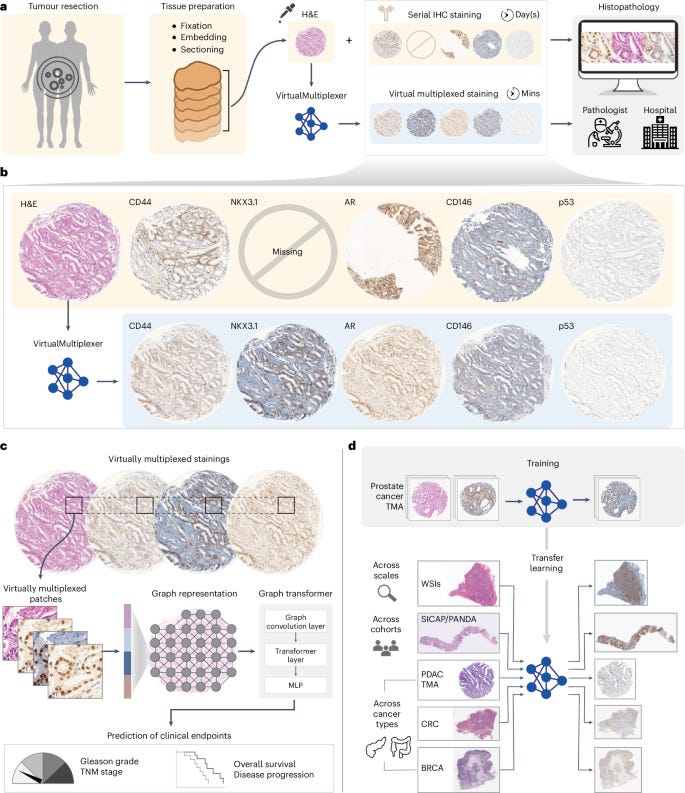
1. Virtual Staining. Serial immunohistochemistry (IHC) staining involves staining consecutive thin sections of a tissue sample with different antibodies, each targeting a specific protein of interest. This process is often required for in-depth tumor profiling. However, it is not only time-consuming and tissue-exhaustive, but can also yield non-aligned tissue images and occasionally result in missing stainings due to tissue unavailability. Could AI generate accurate virtual IHC staining images directly from hematoxylin and eosin (H&E) images instead?
Pati et al. developed VirtualMultiplexer, a generative adversarial network (GAN)-based toolkit that generates realistic virtual IHC images from H&E stained tissue images. Unlike previous models requiring paired, pixel-aligned images, VirtualMultiplexer trains without paired data or extensive annotations while preserving staining consistency. It uses adversarial loss to eliminate style differences between real and virtual patches, and contrastive loss to ensure content consistency between corresponding H&E and virtual IHC patches. A multiscale architecture maintains biological consistency across cellular, neighborhood, and whole-image levels. Trained on prostate cancer tissue microarray images, VirtualMultiplexer successfully transferred across tissue scales and patient cohorts without fine-tuning. Expert evaluation and quantitative metrics confirm that the virtual IHC images are nearly indistinguishable from real ones. Importantly, these virtually multiplexed images enabled the training of early fusion graph transformer models, which consistently improved clinical endpoint predictions across the training dataset, out-of-distribution prostate cancer cohorts, and pancreatic ductal adenocarcinoma (PDAC) tissue microarray cohorts.
Read paper | Nature Machine Intelligence
2. Pathology Foundation Model. While anatomical site information for whole-slide images (WSIs) is frequently available, it remains underutilized in machine-learning models for pathology image analysis.
Wang et al developed CHIEF, a pathology foundation model for cancer diagnosis and prognosis prediction from histopathology images. CHIEF employs a two-stage pretraining process: First, it crops WSI into non-overlapping patches and learns patch-level features via contrastive learning. Second, it integrates these patch-level features using weakly supervised learning and an attention module, generating global pathology representations of the whole-slide images. A pretrained text encoder encodes anatomical site information via simple text prompts (e.g., "This is a histopathological image of the [organ]"). These visual and text features are combined to create richer WSI-level feature representations. Developed using 60,530 WSIs from 19 anatomical sites, CHIEF was validated on 19,491 images from 32 independent datasets across 24 international hospitals and cohorts. The model outperformed state-of-the-art deep learning methods by up to 36.1% in various tasks, including cancer detection, tumor origin identification, molecular profile characterization, and survival prediction, demonstrating its potential as a generalizable pathology foundation model.
Read Paper | Nature
3. Brain Aging. The complex interplay of various factors, including genetic and lifestyle factors and diseases, contribute to the heterogeneity in brain aging. How can we address this heterogeneity across individuals and pathologies when modeling brain changes?
Yang et al. developed an MRI-based measurement system to quantify the severity of individualized brain changes along multiple dimensions, identifying five dominant patterns of brain aging associated with biomedical, lifestyle, and genetic factors. They applied Surreal-GAN, a weakly supervised deep-representation-learning method, to MRI images from a large cohort of 49,482 individuals. This method captures heterogeneous brain changes relative to the reference population, by learning multiple transformations from a reference group (e.g., young and healthy individuals) to a target group (e.g., older adults or patients with specific clinical phenotypes. The result is a set of low-dimensional representation indices, termed R-indices, which indicate the severity of individualized brain changes along five dimensions. The R-indices showed significant positive associations with chronological age and various health outcomes, including disease progression and mortality risk. The R-indices could potentially be used to measure aging trajectories and related brain changes, offering promise for enhancing diagnostic precision, particularly at preclinical stages, and facilitating personalized patient management and targeted clinical trial recruitment based on specific brain endophenotypic expressions.
Read Paper | Nature Medicine
4. Brain Aging. Could AI help us understand the diversity of accelerated brain aging in different populations by quantifying discrepancies between brain age and chronological age?
Moguilner et al. investigated brain aging across diverse populations using functional MRI and EEG data from over 5,000 participants in 15 countries. They developed "brain clock" models using graph convolutional networks (GNN) to predict brain age from neural connectivity patterns. Specifically, they first calculated an adjacency matrix representing interactions between brain regions, which was then converted to a weighted graph as input for the GNN, where nodes represent brain regions and edges represent connections between regions. Models trained on non-LAC (Latin American and Caribbean countries) datasets showed greater convergence with chronological age, while those applied to LAC datasets indicated larger brain-age gaps, suggesting accelerated aging in these populations. They also showed that brain-age gaps increased from healthy controls to mild cognitive impairment to Alzheimer's disease. Females, especially those with Alzheimer's disease in LAC countries, showed significantly larger brain-age gaps than males. Factors like socioeconomic inequality, pollution, and the burden of communicable and noncommunicable diseases were associated with increased brain-age gaps, particularly in LAC. The study highlights how geographical, socioeconomic, and health factors impact brain aging differently across diverse populations.
Read Paper | Nature Medicine
-- Emma Chen, Pranav Rajpurkar & Eric Topol